
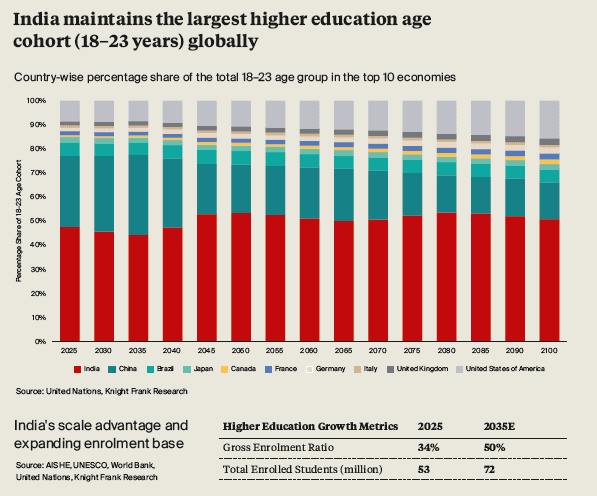
● India hosts the world’s largest higher-education-age population at 155 million, projected to reach 165 million by 2030.
● Over the next 15 years foreign universities have a potential to serve more than 560,000 students, save US$113 billion in forex out go and generate 19 million sq ft demand of education related real estate.
● Delhi NCR, Mumbai, Bengaluru, Ahmedabad, Pune, Chennai and Hyderabad emerge as preferred destinations for foreign campuses.
Deloitte India and Knight Frank India announced the launch of their collaborative study, ‘Global Universities Eye India Opportunity: The Next Big Leap in Higher Education’, which was presented to the Hon’ble Union Minister of Education, Shri Dharmendra Pradhan. Powered by demographic depth, progressive policy reforms and an increasingly supportive city-level ecosystem, India is rapidly becoming a preferred destination for world-leading universities seeking global expansion.
This significant opportunity for India is reinforced by the world’s largest higher‑education‑age cohort of nearly 155 million individuals, expected to reach 165 million by 2030. With a higher education GER target of 50 percent by 2035, the current domestic supply falls short of demand, pushing hundreds of thousands of students abroad annually despite tightening visa regimes in traditional destinations such as the US, U.K., Canada and Australia. This rising outbound mobility, combined with India’s scale and affordability, is encouraging global universities to establish long-term, self-sustaining operations within the country.
The report reinforces those transformational reforms under NEP 2020, and regulatory frameworks from UGC and IFSCA, have opened doors for global universities to operate independently through offshore campuses, joint ventures and transnational models. Supported by tax incentives, liberalised norms and proposed single-window mechanisms, the enabling policy environment is accelerating interest. Already, 18 global universities have received in-principle or final approvals, with three campuses operational, indicating strong early momentum.
Sahil Gupta, Partner, Deloitte India, said, “Amid rising geopolitical uncertainty and tightening immigration policies worldwide, institutions are seeking to diversify beyond traditional Western markets. India’s demographic scale and the policy reforms introduced by UGC and IFSCA have created a once-in-a-generation opportunity for global universities to build long-term, self-sustaining operations in India. India’s combination of cost advantages, an expanding R&D ecosystem and a robust talent pipeline provides a uniquely attractive alternative for global universities.”
By 2040, foreign universities operating in India could serve over 560,000 students, generate US$113 billion in forex savings and create 19 million sq ft of specialised demand for high-quality education-linked real estate. The study also presents a first-of-its-kind city readiness framework evaluating the potential of 40 Indian cities. Delhi NCR emerges as the most prepared market, followed by Bengaluru and Mumbai, each offering deep talent pools, connectivity, research ecosystems and global business networks. Tier II cities such as Chandigarh and Kochi also display mid-scale readiness, offering diverse expansion pathways for international institutions.
Shishir Baijal, International Partner, Chairman and Managing Director, Knight Frank India, said, “India today presents one of the most compelling prospects for global higher education expansion. With 155 million young individuals in the higher-education age bracket and strong economic momentum, the country offers unmatched scale and long-term demand certainty. The entry of leading foreign universities will elevate academic quality, strengthen research collaboration and create significant economic value. As these institutions establish campuses, they will also catalyse specialised real estate development, unlocking new opportunities across India’s education and innovation ecosystem.”
The organisations reaffirmed that the entry of Foreign Higher Educational Institutions (FHEIs) is a step towards globalising India’s education system and a catalyst for innovation, industry-academia collaborations and long-term economic value creation.
As multidisciplinary, innovation-driven education becomes a national priority, India stands poised to develop a globally recognised higher education ecosystem that delivers quality at scale while strengthening its competitiveness as a talent and research powerhouse.